
Imagine waking up at 7 AM, checking your phone, and seeing three sales notifications from products you don’t even own. No customer emails. No shipping headaches. No inventory sitting in your garage. Just commissions hitting your account while you were sleeping.
This is not a fantasy. This is what affiliate marketing looks like when it’s done right.
And here’s something most people don’t realize. According to Statista, global affiliate marketing spending is expected to cross 15.7 billion dollars by the end of 2024, and projections show it touching nearly 40 billion dollars by 2030. The space is not dying. It is exploding. But the rules of the game have changed dramatically, especially with AI tools, cookie-less tracking, and stricter compliance laws shaping the new landscape.
In this guide, I am going to walk you through everything I have learned in over a decade of running affiliate websites and content campaigns. No fluff. No outdated advice. Just the real stuff that actually works in 2026.
What Is Affiliate Marketing?
Affiliate marketing is a performance-based marketing model where you earn a commission by promoting someone else’s product or service. When a person clicks your unique tracking link and makes a purchase or completes an action, you get paid. That’s the whole thing.
Think of it like being a digital salesperson, but without the cold calls, without holding inventory, and without dealing with customer service. You recommend, they buy, you earn.
It is one of the simplest online business models, and yet most beginners overcomplicate it. Let me break it down properly.
How Does Affiliate Marketing Actually Work?
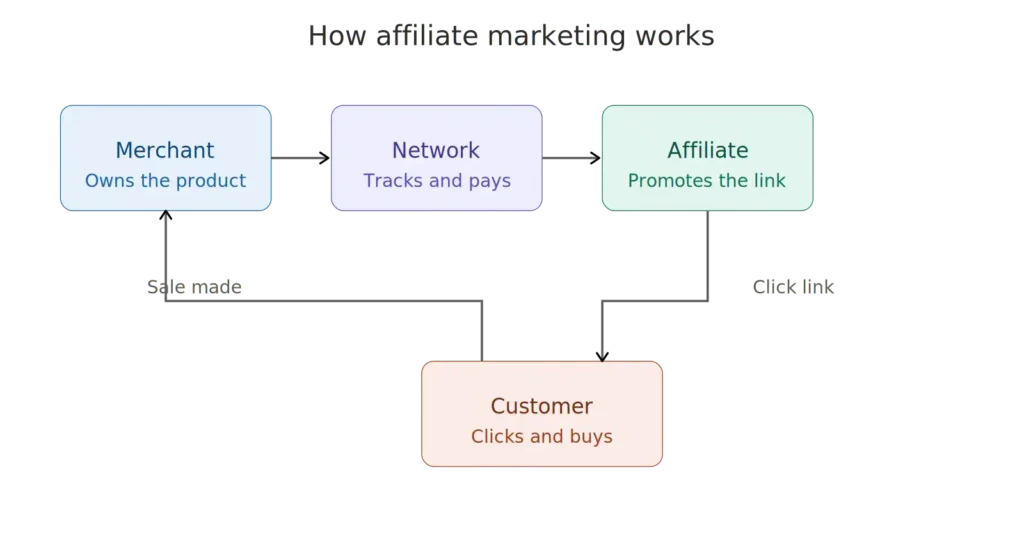
There are four main players in every affiliate marketing transaction.
The Merchant is the company that owns the product. Could be Amazon, could be a small SaaS startup, could be a course creator. They want more sales.
The Affiliate is you. The person who promotes the product through a blog, YouTube channel, Instagram page, email list, or any other medium.
The Customer is the person who clicks your link and buys something. Often, they don’t even know you are getting paid, unless you disclose it (which you legally must, but more on that later).
The Affiliate Network is the middleman platform that tracks the sales and pays you. Networks like Impact, ShareASale, CJ Affiliate, and Awin handle the tech side so merchants and affiliates can focus on what they do best.
Here is the typical flow. You join a program. You get a unique tracking link. You share that link in your content. Someone clicks it. A cookie or server-side identifier is dropped on their device. They buy something within the tracking window, which is usually 24 hours to 90 days depending on the program. You get a commission.
In 2026, tracking has become a lot more complex. Apple’s privacy changes, Google’s third-party cookie phase-out, and stricter GDPR rules have pushed the industry toward first-party data, server-side tracking, and postback URLs. The smart affiliates and merchants have already adapted. The lazy ones are losing data and losing money.
Is Affiliate Marketing Still Worth It in 2026?
Short answer, yes. But it is not the easy money it used to be in 2015.
The barrier to entry is still low. You can technically start with zero dollars if you use free platforms. But the competition is fierce, AI has flooded the internet with mediocre content, and Google now rewards real expertise more than ever before through its EEAT signals (Experience, Expertise, Authoritativeness, Trustworthiness).
What this means is simple. If you bring genuine value, real experience, and unique insight, you will win big. If you copy what everyone else is doing, you will struggle to make your first 100 dollars.
The good news is that consumer trust in influencer and creator recommendations is at an all-time high. People are tired of pushy ads. They want honest opinions from real humans. And that’s exactly what affiliate marketing, done with integrity, delivers.
How Much Money Can You Realistically Make?
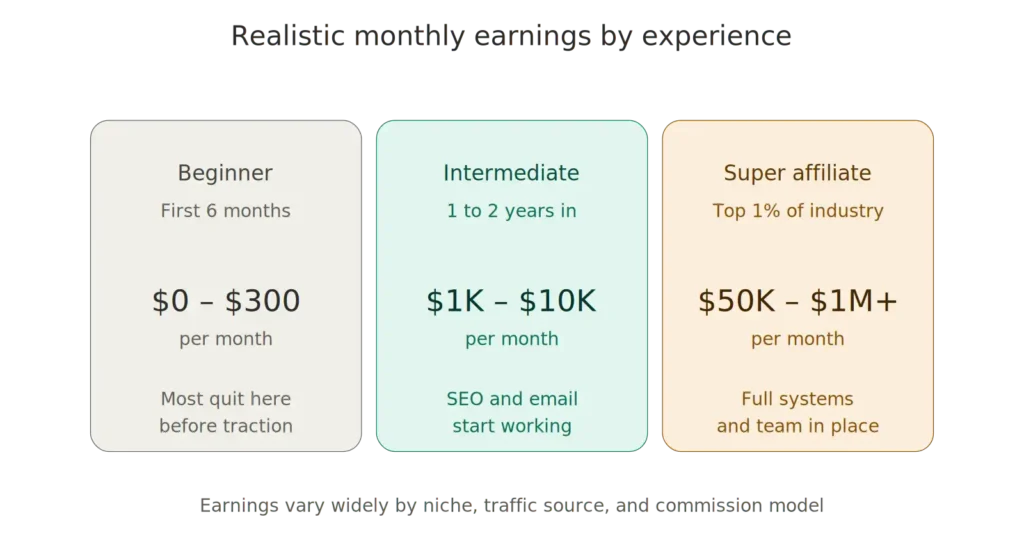
Let me be brutally honest here because most articles on this topic lie to you.
Beginners, in their first six months, usually make somewhere between zero and 300 dollars per month. Some never even reach that. Why? They quit too early, pick the wrong niche, or chase commissions instead of solving real problems.
Intermediate affiliates, those who have been at it for one to two years and have a clear niche, are typically earning 1,000 to 10,000 dollars per month. They have learned SEO, built an email list, and know how to convert traffic.
Super affiliates, the top one percent of the industry, earn anywhere from 50,000 to over a million dollars per month. Yes, per month. People like Pat Flynn, Adam Enfroy, and Michelle Schroeder-Gardner have publicly shared income reports showing six and seven-figure monthly earnings from affiliate revenue alone.
Earnings also vary wildly based on niche. Finance, SaaS, and B2B software affiliates often earn 200 to 1,000 dollars per single sale. Amazon affiliates promoting low-cost household items might earn 50 cents per sale. Same effort, very different outcome.
This is why niche selection matters more than almost anything else.
Top Affiliate Marketing Niches in 2026
Some niches are evergreen. They never go out of style. Finance, health and wellness, software and SaaS, online education, beauty, and home improvement keep generating revenue year after year.
Then there are the emerging niches that are exploding right now. AI tools and prompt engineering, sustainability and eco-friendly products, mental health and self-improvement, the creator economy tools space, pet care, and senior tech are all growing rapidly.
The trick to picking a niche is not to chase the highest commission. It is to find the intersection of three things. What you actually enjoy or know about. What people are willing to spend money on. And what has room for a fresh voice.
If you hate fitness, please do not start a fitness blog just because the commissions look good. You will burn out in three months.
How to Start Affiliate Marketing? (7-Step Roadmap)
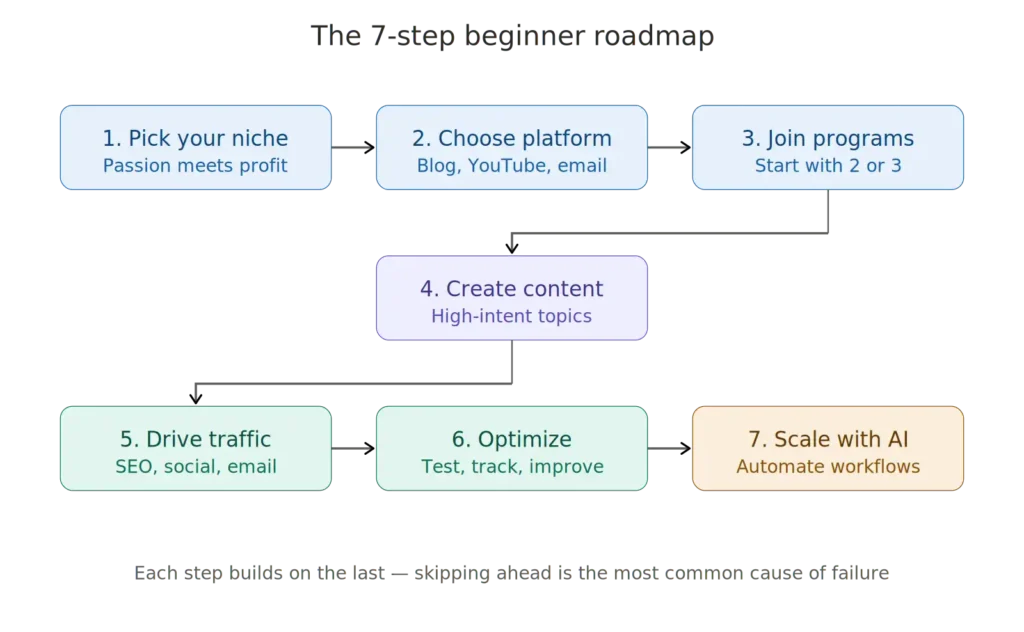
Here is the exact path I would follow if I were starting from zero today.
Step 1: Pick your niche. Spend a week researching, not a month. Analysis paralysis kills more affiliate dreams than competition does.
Step 2: Choose your platform. A blog is great for long-term passive income through SEO. YouTube builds trust faster than any other medium. Newsletters have insane conversion rates. TikTok and Instagram Reels work for product discovery. Pick one and go deep before adding more.
Step 3: Sign up for affiliate programs. Start with two or three. Don’t spread yourself thin trying to promote 20 different products in your first month.
Step 4: Create high-intent content. This is the most important step and the one most beginners get wrong. You don’t make money writing “what is the best laptop” articles in general. You make money writing “best laptop for graphic designers under 1500 dollars in 2026.” The more specific, the better the conversion.
Step 5: Drive traffic. SEO is the slowest but most sustainable. Social media is faster but unpredictable. Email is your secret weapon for repeat conversions. Paid ads work but require capital and skill.
Step 6 Optimize conversions. Track which links get clicked. Test different placements. Use comparison tables. Add real photos and videos of yourself using the product if possible.
Step seven, scale with automation and AI. This is where 2026 differs from previous years. AI tools can help with research, outlines, and editing, but using AI to generate entire articles without human input will get you penalized by Google. Use AI as an assistant, not a replacement.
Best Affiliate Programs to Join in 2026
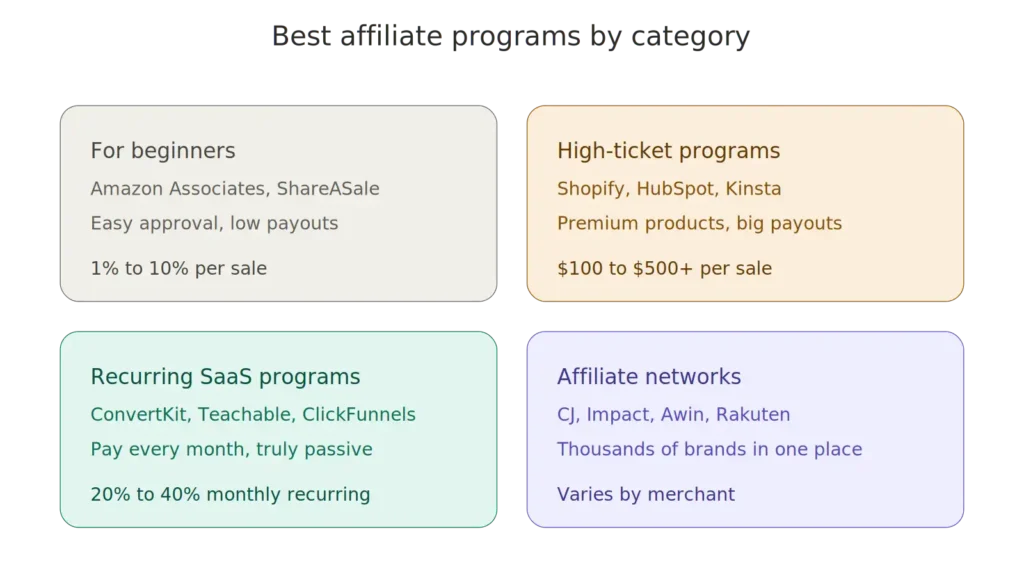
For total beginners, Amazon Associates remains the easiest entry point. The commissions are tiny, usually one to ten percent, but Amazon converts like crazy because everyone already has an account.
For higher payouts, look at programs like Shopify (up to 150 dollars per referral), HubSpot (up to 30 percent recurring), Kinsta (up to 500 dollars per signup plus recurring), and Semrush (up to 200 dollars per sale).
If you want recurring monthly commissions, focus on SaaS products. Tools like ConvertKit, ActiveCampaign, Teachable, and ClickFunnels pay you every single month for as long as the customer stays subscribed. This is how serious affiliates build truly passive income.
Affiliate networks like CJ Affiliate, Impact, Awin, ShareASale, and Rakuten Advertising give you access to thousands of brands under one roof. Sign up for a couple of them and explore.
How AI Is Changing Affiliate Marketing?
This is the part most outdated articles completely miss.
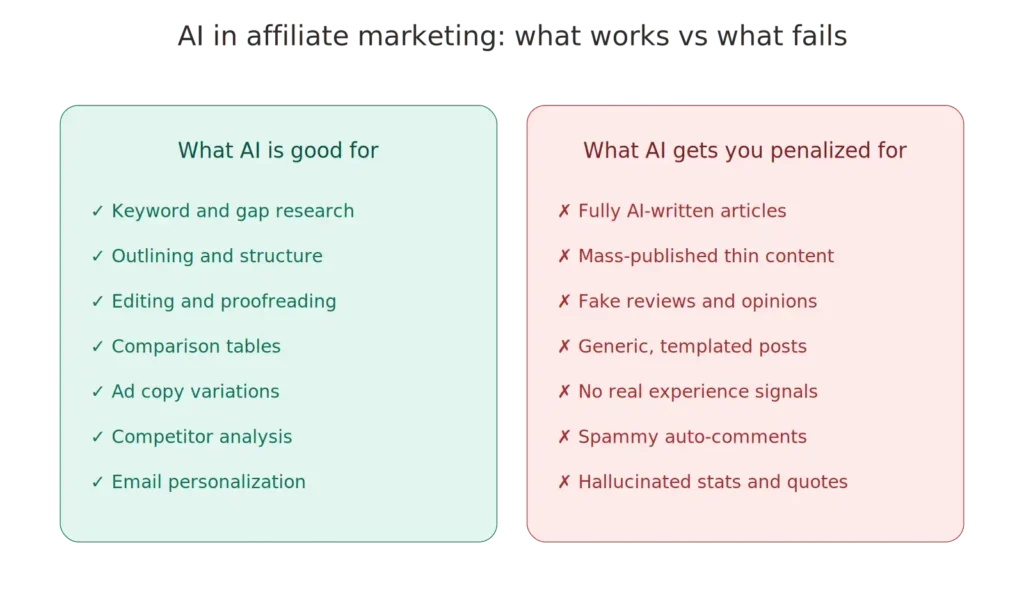
AI has not killed affiliate marketing. It has restructured it. The affiliates who learn to use AI properly are pulling ahead of the pack at lightning speed. Those who use AI to mass-produce garbage content are getting deindexed and losing everything.
Here is what AI is actually good for in affiliate marketing. Keyword research and gap analysis. Outlining and structuring content. Editing and proofreading. Creating product comparison tables. Generating multiple ad copy variations. Analyzing competitor strategies. Personalizing email sequences.
What AI is still bad at. Writing genuinely original opinions. Sharing real-world experience. Building emotional connection. Understanding cultural nuance. Creating content that ranks in 2026 without heavy human editing.
The winning formula is human plus AI. Not AI alone.
Affiliate Marketing Mistakes That Kill Most Beginners
I have seen the same mistakes for over a decade. Let me save you the pain.
Promoting too many products at once destroys your authority. Pick a few and become known for them.
Ignoring search intent is the silent killer. If someone searches for a comparison, they don’t want a definition. Match the intent or get ignored.
Skipping FTC disclosures is not optional. It is illegal. The Federal Trade Commission requires clear and conspicuous disclosure whenever there is a material connection between you and the brand you promote. A small line at the bottom of the post is not enough. The disclosure should be visible before the affiliate links appear.
Choosing low-quality products for higher commissions destroys trust. One bad recommendation can undo a year of credibility building.
Not building an email list is leaving 70 percent of your income on the table. Traffic comes and goes. An email list is yours forever.
FTC Disclosure and Legal Compliance
This is the section most articles skip, but it can literally make or break your business.
In the United States, the FTC has very clear rules. Any time you have a financial relationship with a brand, you must disclose it. The disclosure must be in plain language. Saying “this post contains affiliate links and I may earn a commission at no extra cost to you” near the top of the page is the safest practice.
In Europe, GDPR rules require explicit consent for tracking cookies. In India, the Advertising Standards Council of India has rolled out similar disclosure guidelines for influencers.
Beyond disclosures, remember that affiliate income is taxable income. In most countries, you need to report it. Setting up a basic business structure once you cross a few thousand dollars in monthly income makes tax management much easier.
Affiliate Marketing vs Other Online Income Models
Compared to dropshipping, affiliate marketing has no inventory, no customer service, and lower margins but much lower risk.
Compared to course creation, affiliate marketing starts earning faster but caps lower unless you go super affiliate level.
Compared to sponsorships and brand deals, affiliate marketing is more scalable because you are not limited by time or one-off contracts.
Compared to print-on-demand, affiliate marketing has zero production headache.
For most people starting out with limited capital, affiliate marketing remains the most accessible doorway into online business.
Tools Every Affiliate Marketer Needs
For SEO, Ahrefs and Semrush are industry standards, with Lowfruits as a budget option.
For content creation, a combination of human writing plus AI tools like Claude works wonders.
For link management, Pretty Links and ThirstyAffiliates make organizing affiliate URLs simple.
For analytics, Google Analytics 4 and Microsoft Clarity together give you a complete picture of user behavior.
For email marketing, ConvertKit, Beehiiv, and MailerLite are top picks in 2026.
Frequently Asked Questions
Is affiliate marketing legit?
Yes, completely. It is a multi-billion-dollar industry used by companies like Amazon, Booking.com, and almost every major brand.
How long until I make my first sale?
Most beginners take three to six months of consistent effort. Some get lucky earlier. Most quit before they get there.
Can I do affiliate marketing without a website?
Yes, through YouTube, Instagram, TikTok, Pinterest, or even just an email list. A website helps a lot for SEO, but it is not mandatory.
Do I need to pay taxes on affiliate income?
Yes, in almost every country. Treat it like any other income.
Is affiliate marketing saturated?
Some sub-niches are. But there are always new angles, new platforms, and new audiences. Saturation is mostly a beginner’s excuse.
How much money do I need to start?
You can start with zero. A small budget of 50 to 200 dollars for hosting, a domain, and basic tools is recommended.
Final Thoughts
Affiliate marketing in 2026 is not the get-rich-quick scheme some YouTube gurus make it out to be. It is a real business. It takes real effort, real patience, and real skill.
But the rewards are also very real. Genuine financial freedom. Location independence. The ability to earn while you sleep. And the deeply satisfying feeling of building something that grows even when you step away from your laptop.
The best time to start was ten years ago. The second-best time is right now.
Pick your niche. Choose your platform. Sign up for one good program. Publish your first piece of content this week. That single action puts you ahead of 95 percent of the people who only ever think about starting.
Your future self will thank you for it.
